- Rust 78.5%
- JavaScript 6.6%
- TypeScript 4%
- HTML 4%
- Shell 2%
- Other 4.9%
| Filename | Latest commit message | Latest commit date |
|---|---|---|
 460c7757e6 Ryan approved graduating both full-keyboard experiments. Swipe typing (#2106) and the emoji key and panel (#2051) are on for new users and move out of Experiments. - Defaults: FullKeyboardSettings.emoji and .swipeTyping read experiments.emoji and experiments.swipeTyping as object-or-true (was bool(forKey:), unset meaning off), as spatialAutocorrect did in #2097. Only their Experiments switches ever wrote those keys, and only on a change, so unset means never touched: fresh installs and testers who never touched them get them on, a stored false stays off, a stored true stays on. The keys keep their names; no migration. Without the App Group (no Full Access on an iPhone) both read as on, like the keyboard's other on-by-default switches. --experiment-emoji and --experiment-swipe still turn them on. - Settings › Keyboard: a card under the main one with Swipe typing and Emoji, plus Clear emoji history while Emoji is on. Both keep "Needs the full keyboard" while the Dictation bar is chosen (now from the page's own Full/Dictation bar choice). Settings › Experiments keeps Hinglish and Clean up with Apple Intelligence. No new strings; every string already had zh-Hans. - Record typing logs' session line adds swipeTyping and emoji, beside spatialAutocorrect and cleanupTagger. - settings-<page> scenes write both switches on, as for spatialAutocorrect. Doc comments and README point at Settings › Keyboard. - Test: KeyboardLayoutTests.testSwipeTypingAndEmojiAreOnByDefaultAnd- AStoredOffStaysOff (unset, no App Group, stored off, launch arguments). Held back: Clean up what I say stays off by default. On the held-out generated set its false deletes match the reference (0.5% of words; 3.9% of clean and 2.7% of literal sentences lose a word; 1/43 hand-written clean sentences), and "late" was never deleted (0/247). But it deletes every hyphenated name tried: "Tell Hye-jin I said thanks." became "Tell thanks.", and Jean-Luc, Anne-Marie, Mary-Kate, Ji-woo, Marie-Claire, Smith-Jones and Zeta-Jones all went (P(DELETE) 0.996-1.0), with "follow-up" and "re-entry". It also drops a literal "maybe" ("Call me later, maybe after dinner"). Verified on iPhone 17 simulators (iOS 27.2) on the Mac Studio: - xcodebuild test: 383 tests, 1 skipped (needs HEX_SPEECH_CLIPS), 0 failures. - Swipe on vs off, taps unchanged: the hex-vs-apple held-out sets (2,000 English and 2,000 Spanish sentences) typed through a real KeyboardKeyPlaneView with a temporary, uncommitted harness gave identical output in every sentence and 0 swipes from 116,253 letter touches, for still taps, motion drawn from Record typing logs, every letter dragged 30-95% of a key's pitch, and overlapping (rollover) taps. English WER 5.94%, 79/9,203 correct words broken (still) both ways; Spanish 8.61%, 23/7,978. A control dragging 1.05-1.5 pitches made 7,000/7,000 swipes with it on, 0 off. In the typing logs, 1 of about 1,000 letter touches moved more than a pitch. - Live keyboard in Messages: with no stored keys the emoji key shows and a drag from h to e swipes "He" (strip: Here, Her, He's); with both stored false (an upgrade that turned them off) there's no emoji key and the same drag slides and types "E". - Keyboard memory (Release, Full Access, mock mic, probe transcript, vmmap physical footprint, resident/peak MB, 2 runs each; a temporary, uncommitted probe faked the transcript and headroom): typing, emoji and swipe off 34.0 / 46.1 typing, both on 35.0-39.9 / 47.0-51.8 + in-keyboard dictation, Clean up off 35.0 / 46.6 + dictation, Clean up on 37.6-43.6 / 46.5-51.9 + emoji panel, a few picks 38.3-38.8 / 51.4-52.2 + every emoji category browsed 58.8-59.3 / 68.2-68.3 + all that, then dictation, Clean up 69.2 / 73.7 Typing sets the peak, not the tagger (loaded after recording stops, about 2.6 MB). With a faked 60 MB headroom the 80 MB cleanup guard skipped the tagger and the transcript went in as heard (2/2). The simulator reports no headroom, so #2045's 32 MB start guard can't fire there. On a 4 GB iPhone (reported limits 60-77 MB), browsing every emoji category approaches the limit, and a dictation after it would open Hex instead. Unverified on a device. |
||
| .cargo | ||
| .cloudflare/cache | ||
| .config | ||
| .github | ||
| android | ||
| app | ||
| assets | ||
| crates | ||
| design | ||
| docs | ||
| ios | ||
| macos/HexMicrophoneDriver | ||
| native | ||
| nix | ||
| packaging | ||
| perf | ||
| prototypes/app-shell | ||
| release-notes | ||
| resources | ||
| scripts | ||
| sdk | ||
| site | ||
| skills/hex-personal-commands | ||
| src | ||
| tests | ||
| .gitignore | ||
| .hivemind.toml | ||
| .markdownlint-cli2.jsonc | ||
| AGENTS.md | ||
| build.rs | ||
| Cargo.lock | ||
| Cargo.toml | ||
| clippy.toml | ||
| CONTRIBUTING.md | ||
| flake.lock | ||
| flake.nix | ||
| LICENSE | ||
| README.md | ||
| ROADMAP.md | ||
| SECURITY.md | ||
| strobe.json | ||
| THIRD_PARTY_NOTICES.md | ||
Hex
Hex is local voice dictation for Mac, Windows and Linux. Hold a key, speak, and it pastes.
How it works
- hold the shortcut, speak, then let go
- Hex transcribes on your device and pastes into whatever app you're in
- the first run downloads a speech model; after that nothing leaves your machine
- experimental features live in Labs, at the bottom of the sidebar
What it does
- hold the shortcut to dictate, or set Shortcut mode to Tap to start and stop with a press
- the text lands at the cursor in whatever app you're in
- Option-Shift-V pastes the last dictation again (Ctrl-Alt-V on Windows and Linux)
- History keeps your dictations, searchable, for 7 days by default
- Output runs every dictation through steps you choose (word replacements, built-in cleanups, your own scripts, an optional OpenCode rewrite), with different steps per app or website
- Vocabulary is one list of names Hex should know; Whisper and Qwen3-ASR read it while transcribing, Parakeet models read it with Labs › Vocabulary help on, and the OpenCode rewrite uses it
- Annotate records the screen while you draw and talk, on macOS, Linux and Windows (GNOME Wayland needs Labs › Annotate on GNOME)
- an authenticated local API and the TypeScript SDK transcribe with the same model, for your own tools
- Meetings is a macOS lab that records a call and writes the transcript
Output and History:
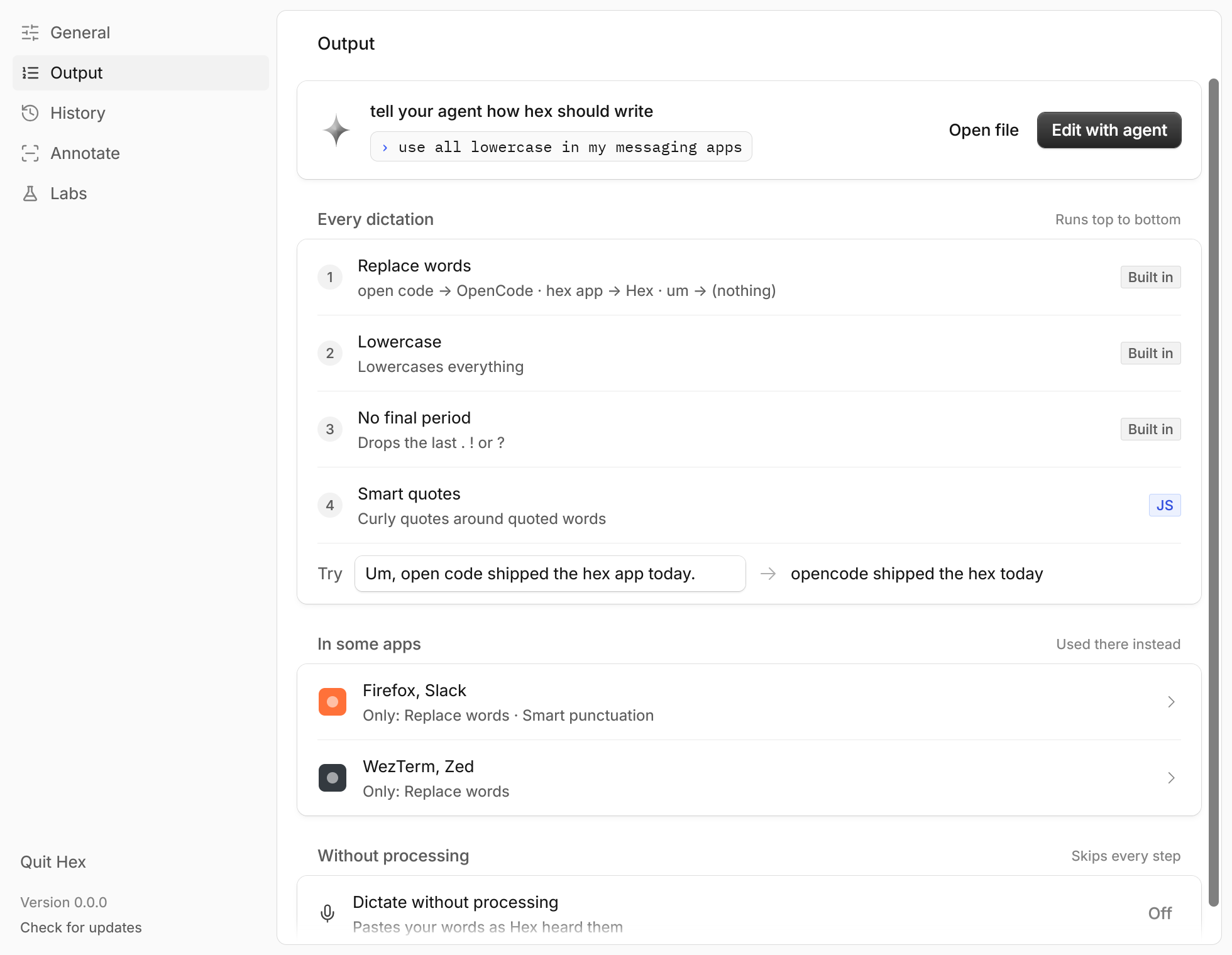

Speech models
Hex downloads one model the first time it runs and transcribes with it on your
machine from then on. On an English system that's Parakeet Unified English: it
writes while you talk, so the text is ready when you let go. Other languages
start with the model recommended for them. That model also serves meetings and
hex transcribe.
Settings' picker offers more, among others:
- Parakeet v3: 25 European languages, and it hears which one you speak
- Cohere Transcribe: the fewest wrong words, in 14 languages; a big download
- Whisper large-v3-turbo: almost any language, and it reads your vocabulary
- Qwen3-ASR 0.6B: Chinese and 29 more, and it reads your vocabulary
- SenseVoice Small: Chinese, Japanese, Korean and English; a small download
- Nemotron 3.5 ASR: writes while you talk, in 27 languages
- Granite Speech 5.0: IBM's model, seven languages, with punctuation
- one-language models: ivrit.ai Whisper for Hebrew, GigaAM v3 for Russian, NB-Whisper for Norwegian, KB-Whisper for Swedish, QwenCleo-ASR for Egyptian Arabic
- more English models: Parakeet v2 and Underdog Bark 3.0
Add a GGUF model of your own with "Add model file…" in the picker; see your own speech models.
Downloads
Stable is the current release. Dev is the newest build of dev and updates
itself from the dev channel.
| Platform | Stable | Dev |
|---|---|---|
| macOS (Apple silicon) | DMG | DMG |
| Windows x64 | Installer | Installer |
| Windows ARM64 | Installer | Installer |
| Linux x86_64 | Executable | Executable |
| Linux x86_64 (Debian, Ubuntu) | .deb | .deb |
| Linux x86_64 (Fedora, openSUSE) | .rpm | .rpm |
| Linux ARM64 | Executable | Executable |
| Linux ARM64 (Debian, Ubuntu) | .deb | .deb |
| Linux ARM64 (Fedora, openSUSE) | .rpm | .rpm |
Or install with:
- Homebrew:
brew install --cask anomalyco/tap/hex - AUR:
yay -S hex-bin - install script (Linux):
curl -fsSL https://anoma.ly/hex/install-linux.sh | sh - Nix (Linux):
nix profile add github:anomalyco/hex
Command line
hex transcribe meeting.m4a prints a recording's transcript, whether or not
the app is running. It reads WAV, AIFF, CAF, FLAC, MP3, Ogg, WebM, and
MP4/M4A/MOV, including a video's soundtrack. The same hex controls the
running app (hex status, hex dictation, hex settings); see
docs/cli.md.
On macOS the CLI is inside the app. Homebrew links it for you; otherwise link
it somewhere on your PATH that you own:
ln -s /Applications/Hex.app/Contents/MacOS/hex ~/.local/bin/hex
Linux and Windows installs put hex on your PATH.
More docs are in docs/.
Contributing
We don't take pull requests. Open an issue describing the bug or idea, and our agents usually turn it around fast.
MIT licensed.