- Rust 78.5%
- JavaScript 6.6%
- TypeScript 4%
- HTML 4%
- Shell 2%
- Other 4.9%
| Filename | Latest commit message | Latest commit date |
|---|---|---|
 8aa283c89f Phase 2 of the iPad keyboard. Docked, Hex had the iPhone's rows at Apple's iPad sizes; now it
has Apple's iPad mini rows (iPadOS 27.2 simulator, black box), used on the 11- and 13-inch too
until their own rows (tab, caps lock, the 13-inch's number row) exist:
- delete ends row 1, return row 2, a shift key on both ends of row 3, and after the letters
Apple's two-symbol keys: , ! and . ? (AZERTY , ? . ! and ' :), drawn with the shifted symbol
over the typed one and typed with shift (new KeyboardKey.shifted);
- bottom row: globe, 123, the Hex key where Apple's dictation key is, space, emoji (123 with
Emoji off) where Apple's second 123 is, hide keyboard. On a docked iPad the Hex key is always
there, whatever Settings › Hex key says; the strip is all suggestions (the layout's
hexPlacement is .leftOfSpace there);
- widths as Apple's: letters as wide as the longest row allows with its delete/return at
least 1.236/1.24 letters, row 2 set in 0.4 of a pitch (0.2 when as long as row 1, AZERTY),
left shift a letter (1.061 on AZERTY), the row-ending keys take the rest, the bottom row the
same in every language;
- 123 and #+= pages as Apple's mini (digits and delete; @ # $ & * ( ) ' " / € £ ¥ _ ^ [ ] { }
and return; a page key either side of % - + = / ; : , . / § | ~ … \ < > ! ?), ABC in place
of Apple's undo and second ABC;
- German on a docked iPad is plain QWERTZ (Apple's iPad German has no ü ö ä keys), holding
ü ö ä on u o a as Hex's plain QWERTZ already does.
New file KeyboardPadRows.swift (KeyboardLayout.buildPadKeys); the phone builder is untouched.
Floating iPads keep Apple's floating (iPhone-like) layout.
Decoder: unchanged code. It still gets only letter keys' frames and the letter pitch
(TypingDecoder.Geometry, AdaptiveTouchGeometry, SwipeDecoder filter on isLetter); the
two-symbol keys are not letters. What changes for it on a docked iPad: the letter frames
(new positions and widths, KeyboardLayout.letterWidth returns the iPad letter width), and
German's letter set, which loses ü ö ä as keys (as Hex's existing plain QWERTZ).
Settings › Keyboard › Number row (#2327, iPhone only) does nothing on an iPad: checked in
the layout tests and on the iPad mini and floating simulators with it on.
Also: FullKeyboardEngineTests.testFrequentlyUsedFillsEightColumns pinned upright
(orientationOverride): on an iPad simulator left in landscape the grid filled with four rows
and was read with three (reproduced on origin/dev, passes now).
Verified (iPadOS 27.2 simulators): Hex against Apple's mini in English, German and French,
upright and turned, every key within a point (overlays in
~/Downloads/hex-ipad-keyboard-2026-11-22/phase2/); real touches on mini, 11- and 13-inch:
teh, -> the, shift , -> !, shift . -> ?, swipe typing, return, delete, the 123 and #+= pages,
the Hex key recording, hide; QWERTZ and AZERTY typing, French ' and shift ' -> : as Apple's,
German holds offering ü and ä; iPhone 17 Pro pixels as origin/dev (light: either build shows
one of two states 53 pixels apart at the glass's left edge, origin/dev included); full suite
747 tests (3 skipped, 0 failures) on an iPhone 17 Pro and an iPad Pro 13-inch simulator.
|
||
| .cargo | ||
| .cloudflare/cache | ||
| .config | ||
| .github | ||
| android | ||
| app | ||
| assets | ||
| crates | ||
| design | ||
| docs | ||
| ios | ||
| macos/HexMicrophoneDriver | ||
| native | ||
| nix | ||
| packaging | ||
| perf | ||
| prototypes/app-shell | ||
| release-notes | ||
| resources | ||
| scripts | ||
| sdk | ||
| site | ||
| skills | ||
| src | ||
| tests | ||
| .gitignore | ||
| .hivemind.toml | ||
| .markdownlint-cli2.jsonc | ||
| AGENTS.md | ||
| build.rs | ||
| Cargo.lock | ||
| Cargo.toml | ||
| clippy.toml | ||
| CONTRIBUTING.md | ||
| flake.lock | ||
| flake.nix | ||
| LICENSE | ||
| README.md | ||
| ROADMAP.md | ||
| SECURITY.md | ||
| strobe.json | ||
| THIRD_PARTY_NOTICES.md | ||
Hex
Hex is local voice dictation for Mac, Windows and Linux. Hold a key, speak, and it pastes.
How it works
- hold the shortcut, speak, then let go
- Hex transcribes on your device and pastes into whatever app you're in
- the first run downloads a speech model; after that nothing leaves your machine
- experimental features live in Labs, at the bottom of the sidebar
What it does
- hold the shortcut to dictate, or set Shortcut mode to Tap to start and stop with a press
- the text lands at the cursor in whatever app you're in
- Option-Shift-V pastes the last dictation again (Ctrl-Alt-V on Windows and Linux)
- History keeps your dictations, searchable, for 7 days by default
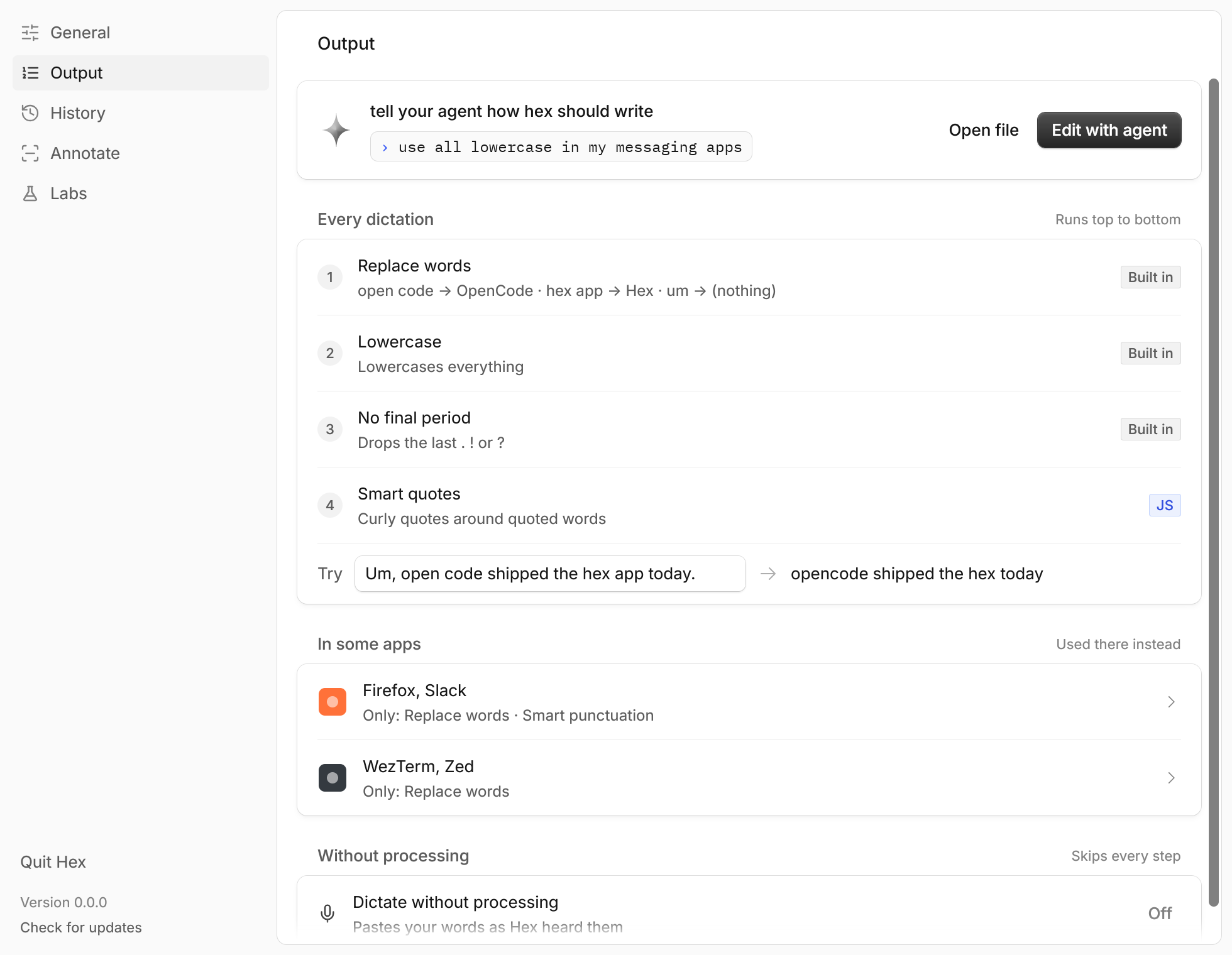
- Output runs every dictation through steps you choose (word replacements, built-in cleanups, your own scripts, an optional OpenCode rewrite), with different steps per app or website
- Vocabulary is one list of names Hex should know; Whisper and Qwen3-ASR read it while transcribing, Parakeet models read it with Labs › Vocabulary help on, and the OpenCode rewrite uses it
- Annotate records the screen while you draw and talk, on macOS, Linux and Windows (GNOME Wayland needs Labs › Annotate on GNOME)
- an authenticated local API and the TypeScript SDK transcribe with the same model, for your own tools
- Meetings is a macOS lab that records a call and writes the transcript
Output and History:

Speech models
Hex downloads one model the first time it runs and transcribes with it on your
machine from then on. On an English system that's Parakeet Unified English: it
writes while you talk, so the text is ready when you let go. Other languages
start with the model recommended for them. That model also serves meetings and
hex transcribe.
Settings' picker offers more, among others:
- Parakeet v3: 25 European languages, and it hears which one you speak
- Cohere Transcribe: the fewest wrong words, in 14 languages; a big download
- Whisper large-v3-turbo: almost any language, and it reads your vocabulary
- Qwen3-ASR 0.6B: Chinese and 29 more, and it reads your vocabulary
- SenseVoice Small: Chinese, Japanese, Korean and English; a small download
- Nemotron 3.5 ASR: writes while you talk, in 27 languages
- Granite Speech 5.0: IBM's model, seven languages, with punctuation
- one-language models: ivrit.ai Whisper for Hebrew, GigaAM v3 for Russian, NB-Whisper for Norwegian, KB-Whisper for Swedish, QwenCleo-ASR for Egyptian Arabic
- more English models: Parakeet v2 and Underdog Bark 3.0
Add a GGUF model of your own with "Add model file…" in the picker; see your own speech models.
Downloads
Stable is the current release. Dev is the newest build of dev and updates
itself from the dev channel.
| Platform | Stable | Dev |
|---|---|---|
| macOS (Apple silicon) | DMG | DMG |
| Windows x64 | Installer | Installer |
| Windows ARM64 | Installer | Installer |
| Linux x86_64 | Executable | Executable |
| Linux x86_64 (Debian, Ubuntu) | .deb | .deb |
| Linux x86_64 (Fedora, openSUSE) | .rpm | .rpm |
| Linux ARM64 | Executable | Executable |
| Linux ARM64 (Debian, Ubuntu) | .deb | .deb |
| Linux ARM64 (Fedora, openSUSE) | .rpm | .rpm |
Or install with:
- Homebrew:
brew install --cask anomalyco/tap/hex - AUR:
yay -S hex-bin - install script (Linux):
curl -fsSL https://anoma.ly/hex/install-linux.sh | sh - Nix (Linux):
nix profile add github:anomalyco/hex
Command line
hex transcribe meeting.m4a prints a recording's transcript, whether or not
the app is running. It reads WAV, AIFF, CAF, FLAC, MP3, Ogg, WebM, and
MP4/M4A/MOV, including a video's soundtrack. The same hex controls the
running app (hex status, hex dictation, hex settings); see
docs/cli.md.
On macOS the CLI is inside the app. Homebrew links it for you; otherwise link
it somewhere on your PATH that you own:
ln -s /Applications/Hex.app/Contents/MacOS/hex ~/.local/bin/hex
Linux and Windows installs put hex on your PATH.
More docs are in docs/.
Contributing
We don't take pull requests. Open an issue describing the bug or idea, and our agents usually turn it around fast.
MIT licensed.