- Rust 78.5%
- JavaScript 6.6%
- TypeScript 4%
- HTML 4%
- Shell 2%
- Other 4.9%
| Filename | Latest commit message | Latest commit date |
|---|---|---|
 f1d965ae5c * Android: Hex Preview, an APK outside Google Play that updates itself Adds a preview build type: the release build (R8, resource shrinking, arm64-v8a, Android 12+) as ly.anoma.hex.preview, named Hex Preview in the launcher and the keyboard list, signed with its own key from ~/.config/hex-android-preview (or HEX_ANDROID_PREVIEW_KEYSTORE_PROPERTIES), never the Play upload key. Its version code is -PhexPreviewBuild (the release script passes dev's commit count) and its name <versionName>-preview.<build>; -PhexPreviewChannel bakes the channel address. The updater lives only in app/src/preview: it reads latest.json from the channel when the app opens and at most once a day when the keyboard opens (never in a password field), shows a card on Home and one dismissible line in the strip, downloads only after Update (size first on mobile data), checks size, SHA-256 and the signing certificate, then installs through PackageInstaller with REQUEST_INSTALL_PACKAGES and UPDATE_PACKAGES_WITHOUT_USER_ACTION. Settings gets Check for updates automatically and Check now; the preview's privacy text says what the check sends. Strings in English and Simplified Chinese. Play builds (debug, release) compile app/src/play's empty Updates, inlined away. Main code gains only the hooks: StripNotice and the strip's notice row, Updates.appOpened in MainActivity.onResume, Updates.keyboardShown in onStartInputView, the two cards on Home, and HexSettings' Label/Card/Rule/Entry/ Toggle/Action made internal for the preview's cards. Verified on anomastudio: testDebugUnitTest and assemblePreview pass; the release bundle requests only RECORD_AUDIO and INTERNET, has no receiver, no PackageInstaller reference, no updater string or resource and no ly.anoma.hex.updates class in its R8 mapping; the preview APK is signed with the preview certificate. Hex 0.2.2 (upload-signed) and Hex Preview install side by side on the API 36 and API 31 emulators with separate keyboards and settings. * Android: preview-release.sh publishes Hex Preview builds; README section android/scripts/preview-release.sh builds the preview APK on the builder Mac (anomastudio by default) from one commit, numbered by git rev-list --count, checks its signing certificate and version before anything is published, creates a pre-release (never latest) tagged android-preview-<build> at that commit with the APK and its SHA-256, confirms the asset serves those bytes, then fast-forwards the channel branch (android-preview) to a commit holding only latest.json and the README people land on. It refuses a commit not on dev for the real channel, an existing tag, or a build not newer than the channel's. --repo and --channel point it at a test channel (a fork). android/README.md gains a Hex Preview section: the build type, the key and its certificate SHA-256, where the updater lives and how builds are numbered. Verified: bash -n; the end-to-end run against a fork follows in this PR. * preview-release.sh: Java for apksigner on the builder; no shell backticks in the release body apksigner needs a JDK on the builder's PATH, which ferry's login shell lacks; the build and the signature check now share one JAVA_HOME/PATH prefix. The release body was written by a bash-expanded heredoc, so its backticks ran the SHA-256 as a command and dropped both hashes from the body; Python now adds them. Verified: build 2305 published to the R44VC0RP/hex-preview-test fork (channel android-preview-test) with this script; its latest.json and README rendered as expected, and the 2305 release body was corrected by hand. * Hex Preview: a strip line that fits, and Version 0.2.2, build N in Check now The strip's update line was cut off on a Pixel 8 (A Hex Preview update is availa…); it now reads Hex Preview update available. Check now named the build twice (Version 0.2.2-preview.2305 · build 2305); it now shows the version without the preview suffix, then the build. Verified from emulator screenshots of build 2305 on API 36. * preview-release.sh: build detached on the builder, so a dropped ferry connection can't stop it A publish of build 2308 died when ferry's connection to the loaded Studio broke mid-build (ferry stops the remote process tree when the caller goes away). The build now runs with ferry sh --detach, writes its exit code to build.exit, and the script polls for it (15 s, up to an hour), printing the log's tail on failure. Verified: build 2308 then published to the test channel on the fork. * Hex Preview: say that updating closes the keyboard for a moment On the API 31 emulator, an update installed while the keyboard was open in another app closed that keyboard, and it stayed closed until the field was tapped again (API 36: until another field took focus). Hex Preview stays the selected keyboard throughout. The update card now says so under Update and while installing, in English and Simplified Chinese. Verified: compilePreviewKotlin on anomastudio; the behaviour itself on the API 31 emulator with build 2308. * preview-release.sh: retry the builder steps when ferry's connection drops Under heavy load on the Studio, ferry's pipe to it broke on several steps of a publish (copy, signature check, fetching the APK). Each builder step is safe to repeat, so they now retry up to five times, and the detached build is not started twice if its log already exists. Verified: build 2310 published to the fork's test channel with this script. |
||
| .cargo | ||
| .cloudflare/cache | ||
| .config | ||
| .github | ||
| android | ||
| app | ||
| assets | ||
| crates | ||
| design | ||
| docs | ||
| ios | ||
| macos/HexMicrophoneDriver | ||
| native | ||
| nix | ||
| packaging | ||
| perf | ||
| prototypes/app-shell | ||
| release-notes | ||
| resources | ||
| scripts | ||
| sdk | ||
| site | ||
| skills | ||
| src | ||
| tests | ||
| .gitignore | ||
| .hivemind.toml | ||
| .markdownlint-cli2.jsonc | ||
| AGENTS.md | ||
| build.rs | ||
| Cargo.lock | ||
| Cargo.toml | ||
| clippy.toml | ||
| CONTRIBUTING.md | ||
| flake.lock | ||
| flake.nix | ||
| LICENSE | ||
| README.md | ||
| ROADMAP.md | ||
| SECURITY.md | ||
| strobe.json | ||
| THIRD_PARTY_NOTICES.md | ||
Hex
Hex is local voice dictation for Mac, Windows and Linux. Hold a key, speak, and it pastes.
How it works
- hold the shortcut, speak, then let go
- Hex transcribes on your device and pastes into whatever app you're in
- the first run downloads a speech model; after that nothing leaves your machine
- experimental features live in Labs, at the bottom of the sidebar
What it does
- hold the shortcut to dictate, or set Shortcut mode to Tap to start and stop with a press
- the text lands at the cursor in whatever app you're in
- Option-Shift-V pastes the last dictation again (Ctrl-Alt-V on Windows and Linux)
- History keeps your dictations, searchable, for 7 days by default
- Output runs every dictation through steps you choose (word replacements, built-in cleanups, your own scripts, an optional OpenCode rewrite), with different steps per app or website
- Vocabulary is one list of names Hex should know; Whisper and Qwen3-ASR read it while transcribing, Parakeet models read it with Labs › Vocabulary help on, and the OpenCode rewrite uses it
- Annotate records the screen while you draw and talk, on macOS, Linux and Windows (GNOME Wayland needs Labs › Annotate on GNOME)
- an authenticated local API and the TypeScript SDK transcribe with the same model, for your own tools
- Meetings is a macOS lab that records a call and writes the transcript
Output and History:
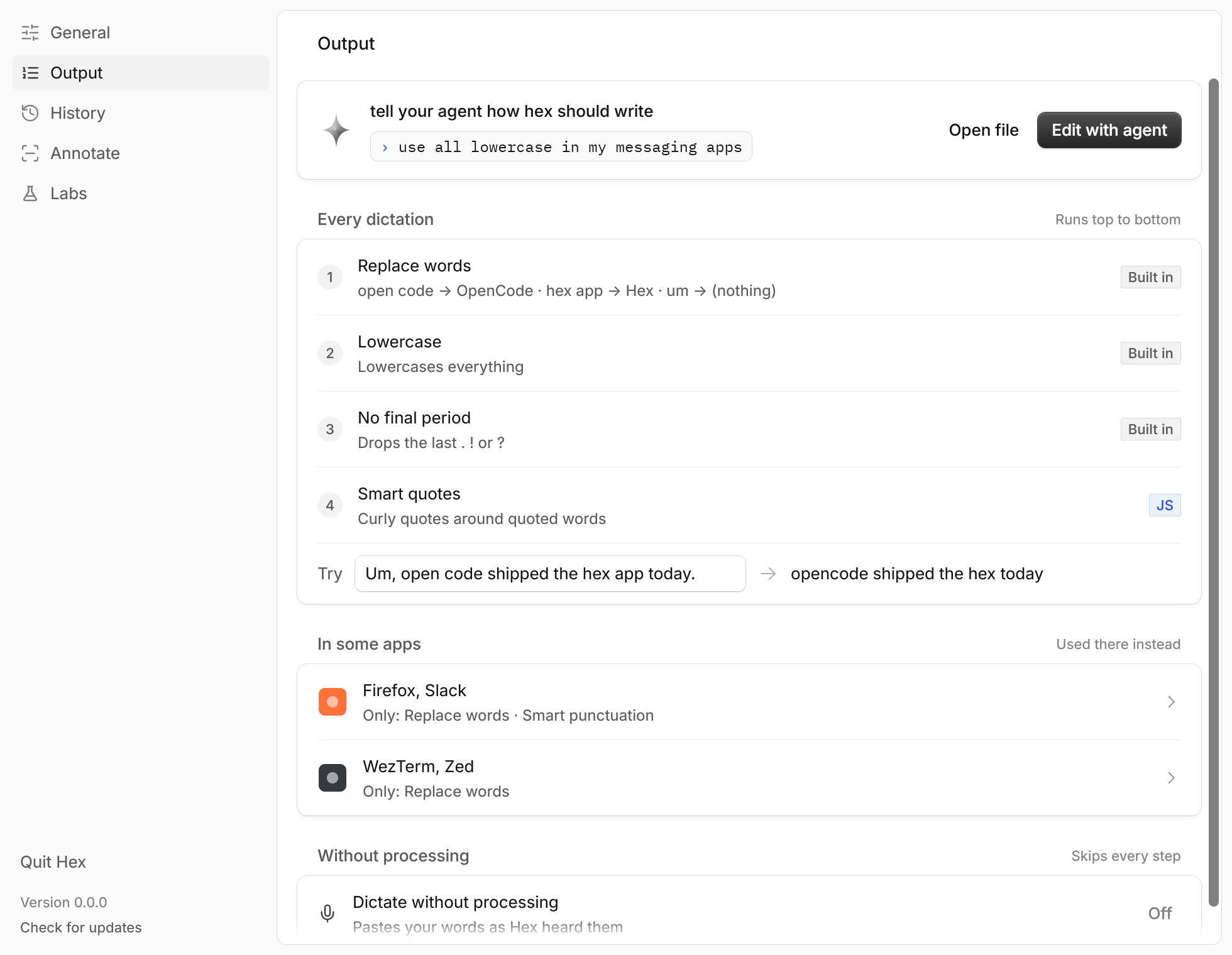

Speech models
Hex downloads one model the first time it runs and transcribes with it on your
machine from then on. On an English system that's Parakeet Unified English: it
writes while you talk, so the text is ready when you let go. Other languages
start with the model recommended for them. That model also serves meetings and
hex transcribe.
Settings' picker offers more, among others:
- Parakeet v3: 25 European languages, and it hears which one you speak
- Cohere Transcribe: the fewest wrong words, in 14 languages; a big download
- Whisper large-v3-turbo: almost any language, and it reads your vocabulary
- Qwen3-ASR 0.6B: Chinese and 29 more, and it reads your vocabulary
- SenseVoice Small: Chinese, Japanese, Korean and English; a small download
- Nemotron 3.5 ASR: writes while you talk, in 27 languages
- Granite Speech 5.0: IBM's model, seven languages, with punctuation
- one-language models: ivrit.ai Whisper for Hebrew, GigaAM v3 for Russian, NB-Whisper for Norwegian, KB-Whisper for Swedish, QwenCleo-ASR for Egyptian Arabic
- more English models: Parakeet v2 and Underdog Bark 3.0
Add a GGUF model of your own with "Add model file…" in the picker; see your own speech models.
Downloads
Stable is the current release. Dev is the newest build of dev and updates
itself from the dev channel.
| Platform | Stable | Dev |
|---|---|---|
| macOS (Apple silicon) | DMG | DMG |
| Windows x64 | Installer | Installer |
| Windows ARM64 | Installer | Installer |
| Linux x86_64 | Executable | Executable |
| Linux x86_64 (Debian, Ubuntu) | .deb | .deb |
| Linux x86_64 (Fedora, openSUSE) | .rpm | .rpm |
| Linux ARM64 | Executable | Executable |
| Linux ARM64 (Debian, Ubuntu) | .deb | .deb |
| Linux ARM64 (Fedora, openSUSE) | .rpm | .rpm |
Or install with:
- Homebrew:
brew install --cask anomalyco/tap/hex - AUR:
yay -S hex-bin - install script (Linux):
curl -fsSL https://anoma.ly/hex/install-linux.sh | sh - Nix (Linux):
nix profile add github:anomalyco/hex
Command line
hex transcribe meeting.m4a prints a recording's transcript, whether or not
the app is running. It reads WAV, AIFF, CAF, FLAC, MP3, Ogg, WebM, and
MP4/M4A/MOV, including a video's soundtrack. The same hex controls the
running app (hex status, hex dictation, hex settings); see
docs/cli.md.
On macOS the CLI is inside the app. Homebrew links it for you; otherwise link
it somewhere on your PATH that you own:
ln -s /Applications/Hex.app/Contents/MacOS/hex ~/.local/bin/hex
Linux and Windows installs put hex on your PATH.
More docs are in docs/.
Contributing
We don't take pull requests. Open an issue describing the bug or idea, and our agents usually turn it around fast.
MIT licensed.