* Android: Hex Preview hands updates to the browser and installs nothing itself

Why: Google Play Protect blocks Hex Preview 2332 as a harmful app. Google's scans of builds of
52fde4b7 flag every build that requests REQUEST_INSTALL_PACKAGES, with or without an updater,
and pass every build without it, the in-app updater's code included:
  Build  Install permissions requested               Updater                         Library   Google       Scan
  T1     REQUEST_INSTALL_PACKAGES, UPDATE_PACKAGES_  in-app (as shipped)             stock     harmful      8.9 s
  T2     none                                        none (Play code)                stock     SAFE         5.6 s
  T3     none                                        none (Play code)                hardened  SAFE         5.9 s
  T4     REQUEST_INSTALL_PACKAGES, UPDATE_PACKAGES_  in-app (as shipped)             hardened  harmful      5.2 s
  (d)    REQUEST_INSTALL_PACKAGES, UPDATE_PACKAGES_  in-app (as shipped)             hardened  harmful      7.1 s
  (e)    none                                        in-app code, no permissions     hardened  SAFE         7.5 s
  T5     REQUEST_INSTALL_PACKAGES                    in-app, Android's dialog always hardened  harmful      7.0 s
  T6     REQUEST_INSTALL_PACKAGES                    none (Play code)                hardened  harmful      6.3 s
  T7     none                                        browser hand-off (this change)  hardened  SAFE         8.2 s
  harmful = POTENTIALLY_UNWANTED / generic_malware; UPDATE_PACKAGES_ = UPDATE_PACKAGES_WITHOUT_USER_ACTION.
  T1-T7: throwaway package names (dev.kbprobe.tN) and keys; (d), (e): ly.anoma.hex.preview, preview key.
So Hex Preview keeps its update check and drops the install permission and its installer: no
PackageInstaller. Android's own installer, reached through the browser, asks the person and
accepts only an APK signed with Hex Preview's key.

What changed:
- Manifest: REQUEST_INSTALL_PACKAGES, UPDATE_PACKAGES_WITHOUT_USER_ACTION,
  ACCESS_NETWORK_STATE, RUN_USER_INITIATED_JOBS, UpdateReceiver and UpdateJob removed; the
  preview APK declares only main's RECORD_AUDIO and INTERNET.
- Updates.kt: the check is unchanged (latest.json when the app opens and at most once a day from
  the keyboard, the strip notice, the Home card with version, size, date and notes, Settings'
  Check now and automatic switch). Download update opens latest.json's apk.url (Release accepts
  only a GitHub HTTPS address) with ACTION_VIEW. Downloads earlier builds left in the cache are
  deleted.
- Removed behaviour: the in-app download and its progress, the mobile-data size confirmation,
  the size, SHA-256, package and signing-key checks before installing (Android's installer still
  refuses an update signed with another key), the Android 14+ background download job and its
  notification, the PackageInstaller session and its status receiver, the in-app Install
  unknown apps prompt and the failure states. Channel.kt keeps only latest(); UpdateJob.kt is
  deleted; the 20 strings only they used are removed in English and Chinese.
- Home card: the button reads "Download update"; a note says the browser downloads it from
  GitHub, open the download and tap Update when Android asks, and the first time Android may
  ask to allow the browser to install apps. English and Simplified Chinese.
- android/README.md's Hex Preview section and the channel README that
  scripts/preview-release.sh writes describe the hand-off.

What a person sees:
- Before: Update; on mobile data the size, then Download; in-app progress, "Checking the
  download…"; the first time, Android's Install unknown apps switch for Hex Preview; Android's
  update dialog on the first in-app update, later ones with no dialog; the keyboard closes for a
  moment.
- After: Download update; the browser opens and downloads the APK from GitHub; open the
  download; the first time, Android asks to allow the browser to install apps (already allowed
  if Hex Preview was installed from that browser); Android's "Do you want to update this app?",
  tap Update; the keyboard closes for a moment.

Verified: ./gradlew :app:testDebugUnitTest :app:testPreviewUnitTest (136 tests each, 0
failures) and :app:assemblePreview green. The preview APK declares only RECORD_AUDIO and
INTERNET, its dex has no createSession, canRequestPackageInstalls or setRequireUserAction, and
it declares no update receiver or job. The preview sources are byte-identical to scan build T7.
No unit test added: nothing new is pure, and the shared test sources also compile against the
Play variant, which has no updater. Not run on a device.

* Android: Hex Preview's Update opens only its own channel's release files

Why: with the browser hand-off, Hex Preview no longer checks the download's size, SHA-256 or
signing key; the browser opens whatever latest.json's apk.url names. Until now that could be any
HTTPS address on the four GitHub hosts.

The rule: apk.url must be https://github.com/<owner>/<repo>/releases/download/<tag>/<name>.apk,
<owner>/<repo> taken from the build's own channel address (update_channel,
https://raw.githubusercontent.com/<owner>/<repo>/<branch>/latest.json). No user info, query or
fragment, the default port; the tag and file name are letters, digits, '.', '_' and '-' starting
with a letter or digit, so no '..' or percent-escapes. A test channel on a fork opens only that
fork's releases; the real channel only anomalyco/hex's. Anything else fails latest.json as a
malformed one does (Problem.Server): no update card, and Check now says "Couldn't check". A
release saved by an earlier check is held to the same rule. The four-host list still governs
fetching latest.json and its redirects.

Removed behaviour: an apk.url in another repository, on raw.githubusercontent.com or the asset
hosts, over http, or anything but a release .apk is no longer offered.

Verified:
- ./gradlew :app:testDebugUnitTest :app:assemblePreview green.
- The same logic in jshell: the real channel's build 2332 address is accepted; another
  repository, http, raw.githubusercontent.com, a query, a fragment, user info, port 8443, '..',
  '%2e%2e', .APK, a missing tag, a nested path, a similar repo name and a trailing-dot host are
  rejected.
- By hand on an Android 16 emulator (AVD hex-playprotect-vogel), a debug-signed preview build
  whose latest.json came from a local server. The throwaway test copy changed only the fetch
  line, cleartext and opening on Home; the channel string, parsing, the rule and the UI were as
  shipped. Another repository, http and raw.githubusercontent.com: no update card, Check now
  "Couldn't check", no browser. A good address: the card, and Download update opened
  github.com/anomalyco/hex/releases/download/... in Chrome (ACTION_VIEW).
Hex is local voice dictation for Mac, Windows and Linux. Hold a key, speak, and
it pastes.
How it works
hold the shortcut, speak, then let go
Hex transcribes on your device and pastes into whatever app you're in
the first run downloads a speech model; after that nothing leaves your machine
experimental features live in Labs, at the bottom of the sidebar
What it does
hold the shortcut to dictate, or set Shortcut mode to Tap to start and stop
with a press
the text lands at the cursor in whatever app you're in
Option-Shift-V pastes the last dictation again (Ctrl-Alt-V on Windows and Linux)
History keeps your dictations, searchable, for 7 days by default
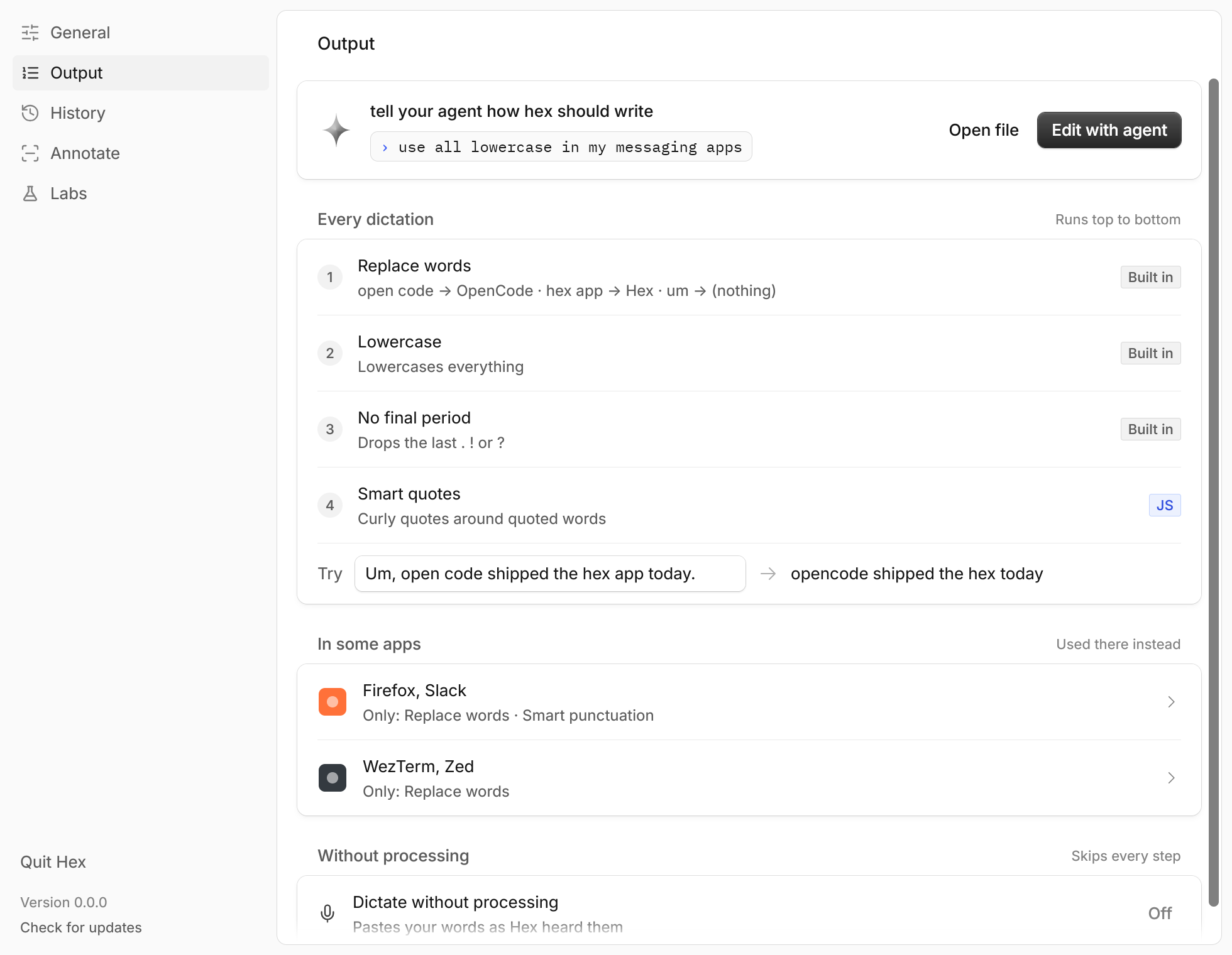
Output runs every dictation through steps you choose (word replacements,
built-in cleanups, your own scripts, an optional OpenCode rewrite), with
different steps per app or website
Vocabulary is one list of names Hex should know; Whisper and Qwen3-ASR read
it while transcribing, Parakeet models read it with Labs › Vocabulary help
on, and the OpenCode rewrite uses it
Annotate records the screen while you draw and talk, on macOS, Linux and
Windows (GNOME Wayland needs Labs › Annotate on GNOME)
an authenticated local API and the TypeScript SDK
transcribe with the same model, for your own tools
Meetings is a macOS lab that records a call and writes the transcript
Output and History:
Speech models
Hex downloads one model the first time it runs and transcribes with it on your
machine from then on. On an English system that's Parakeet Unified English: it
writes while you talk, so the text is ready when you let go. Other languages
start with the model recommended for them. That model also serves meetings and
hex transcribe.
Settings' picker offers more, among others:
Parakeet v3: 25 European languages, and it hears which one you speak
Cohere Transcribe: the fewest wrong words, in 14 languages; a big download
Whisper large-v3-turbo: almost any language, and it reads your vocabulary
Qwen3-ASR 0.6B: Chinese and 29 more, and it reads your vocabulary
SenseVoice Small: Chinese, Japanese, Korean and English; a small download
Nemotron 3.5 ASR: writes while you talk, in 27 languages
Granite Speech 5.0: IBM's model, seven languages, with punctuation
one-language models: ivrit.ai Whisper for Hebrew, GigaAM v3 for Russian,
NB-Whisper for Norwegian, KB-Whisper for Swedish, QwenCleo-ASR for Egyptian
Arabic
more English models: Parakeet v2 and Underdog Bark 3.0
Add a GGUF model of your own with "Add model file…" in the picker; see
your own speech models.
Downloads
Stable is the current release. Dev is the newest build of dev and updates
itself from the dev channel.
install script (Linux): curl -fsSL https://anoma.ly/hex/install-linux.sh | sh
Nix (Linux): nix profile add github:anomalyco/hex
Command line
hex transcribe meeting.m4a prints a recording's transcript, whether or not
the app is running. It reads WAV, AIFF, CAF, FLAC, MP3, Ogg, WebM, and
MP4/M4A/MOV, including a video's soundtrack. The same hex controls the
running app (hex status, hex dictation, hex settings); see
docs/cli.md.
On macOS the CLI is inside the app. Homebrew links it for you; otherwise link
it somewhere on your PATH that you own:
 1f467eff23