- Rust 78.5%
- JavaScript 6.6%
- TypeScript 4%
- HTML 4%
- Shell 2%
- Other 4.9%
| Filename | Latest commit message | Latest commit date |
|---|---|---|
 2e7fc060ed TestFlight (build 32, iOS 27.2.1): onboarding's practice field said the microphone wasn't allowed after it had been, until Skip for now. Cause (reproduced on an iOS 27.2 simulator): a keyboard process keeps the microphone permission it read when it started. AVAudioApplication, AVAudioSession and AVCaptureDevice all still read "undetermined" in it after Hex is allowed the mic, so a Hex keyboard opened before the grant (tried in another app first, then onboarding) hits KeyboardLocalDictation's guard and shows "Allow the microphone in Hex first" on the Try the keyboard page. The app and the try page had the right state; only the keyboard's own reading was stale. What changed - KeyboardBridge.appMicrophoneAllowed (App Group key app.microphoneAllowed): the app's own reading, written by KeyboardSetupMonitor.refresh (every second on onboarding and home, on becoming active, and after the mic prompt), only when it changes. - KeyboardLocalDictation.start accepts the mic when its own reading or the app's says granted; WebKit's capture still checks, and a NotAllowedError still shows the same message. The probe log notes app=granted|no. - Nothing removed. Onboarding is unchanged: #2058's no Allow button before the prompt, and Continue after a decline, stay as they are. #2058 made this easier to hit, not the cause: build 32 needed the mic for Continue, so it took a keyboard opened earlier; now declining leads to the try page with the keyboard open, and allowing it later in Settings left that keyboard stale too. Verified (anomastudio, iPhone 18 Pro Max simulator, iOS 27.2, fresh install, mic reset, Full Access via TCC): Hex keyboard tried in Spotlight first, then onboarding with the mic allowed at the system prompt. Before: same keyboard pid, mic=undetermined, "Allow the microphone in Hex first" on the try page. After: same pid, mic=undetermined app=granted, web capture started in the practice field. xcodebuild test: 267 tests, 0 failures, 1 skipped. Not verified: a physical iPhone (the simulator's WebKit captures without a TCC check and has no speech assets), or a keyboard that started with the mic denied and was allowed in Settings. |
||
| .cargo | ||
| .cloudflare/cache | ||
| .config | ||
| .github | ||
| app | ||
| assets | ||
| crates | ||
| design | ||
| docs | ||
| ios | ||
| macos/HexMicrophoneDriver | ||
| native | ||
| nix | ||
| packaging | ||
| perf | ||
| prototypes/app-shell | ||
| release-notes | ||
| resources | ||
| scripts | ||
| sdk | ||
| site | ||
| skills/hex-personal-commands | ||
| src | ||
| tests | ||
| .gitignore | ||
| .hivemind.toml | ||
| .markdownlint-cli2.jsonc | ||
| AGENTS.md | ||
| build.rs | ||
| Cargo.lock | ||
| Cargo.toml | ||
| clippy.toml | ||
| CONTRIBUTING.md | ||
| flake.lock | ||
| flake.nix | ||
| LICENSE | ||
| README.md | ||
| ROADMAP.md | ||
| SECURITY.md | ||
| strobe.json | ||
| THIRD_PARTY_NOTICES.md | ||
Hex
Hex is local voice dictation for Mac, Windows and Linux. Hold a key, speak, and it pastes.
How it works
- hold the shortcut, speak, then let go
- Hex transcribes on your device and pastes into whatever app you're in
- the first run downloads a speech model; after that nothing leaves your machine
- experimental features live in Labs, at the bottom of the sidebar
What it does
- hold the shortcut to dictate, or set Shortcut mode to Tap to start and stop with a press
- the text lands at the cursor in whatever app you're in
- Option-Shift-V pastes the last dictation again (Ctrl-Alt-V on Windows and Linux)
- History keeps your dictations, searchable, for 7 days by default
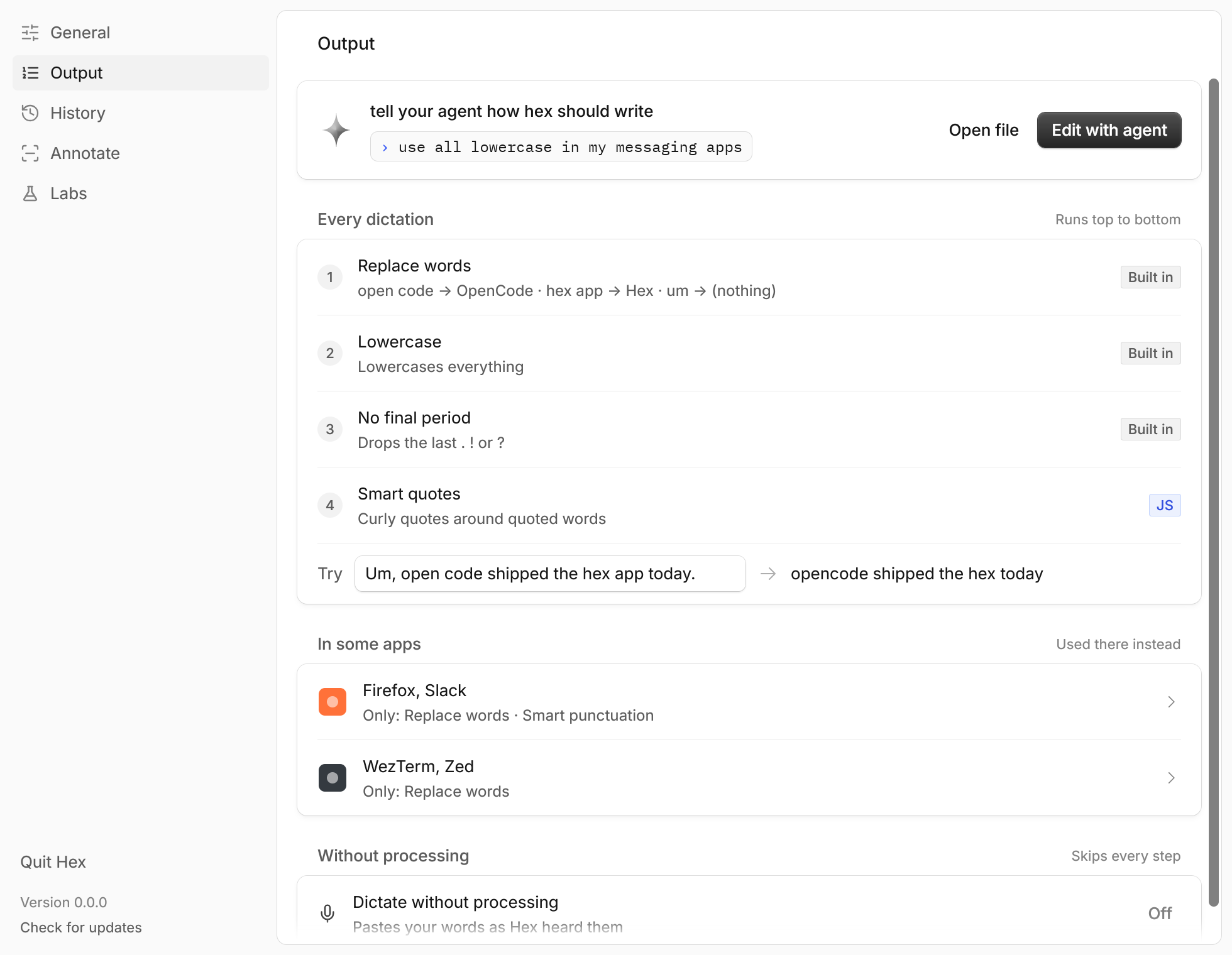
- Output runs every dictation through steps you choose (word replacements, built-in cleanups, your own scripts, an optional OpenCode rewrite), with different steps per app or website
- Vocabulary is one list of names Hex should know; Whisper and Qwen3-ASR read it while transcribing, Parakeet models read it with Labs › Vocabulary help on, and the OpenCode rewrite uses it
- Annotate records the screen while you draw and talk, on macOS, Linux and Windows (GNOME Wayland needs Labs › Annotate on GNOME)
- an authenticated local API and the TypeScript SDK transcribe with the same model, for your own tools
- Meetings is a macOS lab that records a call and writes the transcript
Output and History:

Speech models
Hex downloads one model the first time it runs and transcribes with it on your
machine from then on. On an English system that's Parakeet Unified English: it
writes while you talk, so the text is ready when you let go. Other languages
start with the model recommended for them. That model also serves meetings and
hex transcribe.
Settings' picker offers more, among others:
- Parakeet v3: 25 European languages, and it hears which one you speak
- Cohere Transcribe: the fewest wrong words, in 14 languages; a big download
- Whisper large-v3-turbo: almost any language, and it reads your vocabulary
- Qwen3-ASR 0.6B: Chinese and 29 more, and it reads your vocabulary
- SenseVoice Small: Chinese, Japanese, Korean and English; a small download
- Nemotron 3.5 ASR: writes while you talk, in 27 languages
- Granite Speech 5.0: IBM's model, seven languages, with punctuation
- one-language models: ivrit.ai Whisper for Hebrew, GigaAM v3 for Russian, NB-Whisper for Norwegian, KB-Whisper for Swedish, QwenCleo-ASR for Egyptian Arabic
- more English models: Parakeet v2 and Underdog Bark 3.0
Add a GGUF model of your own with "Add model file…" in the picker; see your own speech models.
Downloads
Stable is the current release. Dev is the newest build of dev and updates
itself from the dev channel.
| Platform | Stable | Dev |
|---|---|---|
| macOS (Apple silicon) | DMG | DMG |
| Windows x64 | Installer | Installer |
| Windows ARM64 | Installer | Installer |
| Linux x86_64 | Executable | Executable |
| Linux x86_64 (Debian, Ubuntu) | .deb | .deb |
| Linux x86_64 (Fedora, openSUSE) | .rpm | .rpm |
| Linux ARM64 | Executable | Executable |
| Linux ARM64 (Debian, Ubuntu) | .deb | .deb |
| Linux ARM64 (Fedora, openSUSE) | .rpm | .rpm |
Or install with:
- Homebrew:
brew install --cask anomalyco/tap/hex - AUR:
yay -S hex-bin - install script (Linux):
curl -fsSL https://anoma.ly/hex/install-linux.sh | sh - Nix (Linux):
nix profile add github:anomalyco/hex
Command line
hex transcribe meeting.m4a prints a recording's transcript, whether or not
the app is running. It reads WAV, AIFF, CAF, FLAC, MP3, Ogg, WebM, and
MP4/M4A/MOV, including a video's soundtrack. The same hex controls the
running app (hex status, hex dictation, hex settings); see
docs/cli.md.
On macOS the CLI is inside the app. Homebrew links it for you; otherwise link
it somewhere on your PATH that you own:
ln -s /Applications/Hex.app/Contents/MacOS/hex ~/.local/bin/hex
Linux and Windows installs put hex on your PATH.
More docs are in docs/.
Contributing
We don't take pull requests. Open an issue describing the bug or idea, and our agents usually turn it around fast.
MIT licensed.