- Rust 78.5%
- JavaScript 6.6%
- TypeScript 4%
- HTML 4%
- Shell 2%
- Other 4.9%
| Filename | Latest commit message | Latest commit date |
|---|---|---|
 e8d82f7101 * iOS: make the app's interface strings localizable
Strings built as String values (status lines, menu and segment labels,
settings rows, errors, notices, shared model labels) never reached a
string table, so a translation couldn't replace them. They now go
through String(localized:), and the app's own small components that
only take literals (onboarding buttons and rows, page titles, section
headers, setup sheet rows) take LocalizedStringKey. English output is
unchanged.
- "1 step"/"N steps", "N event(s)" and "N dictation(s) learned" no
longer glue English words together; the plural lives in the catalog
or in two whole sentences, so other languages can order them.
- Where you tap off-centre names the eight directions as whole phrases
instead of joining "low" + " and " + "right".
- Language names in messages ("Russian isn't available...", "Use
English", "Paste in Spanish") follow Hex's interface language
(Locale.hexInterface, the bundle's preferred localization) instead of
always English. SpeechModelUnavailable.englishName is renamed
interfaceName. The keyboard has no translations yet, so it still says
English.
- project.yml turns on SWIFT_EMIT_LOC_STRINGS and
LOCALIZATION_PREFERS_STRING_CATALOGS so the compiler extracts these
strings for String Catalogs; without it, an export found only ~50 of
the app's ~230 strings.
Not touched: HEXKeyboard/ and the keyboard's views in
HEXShared/FullKeyboard and KeyboardSurface.swift.
Verified on the Mac Studio (iOS 27.2 simulator, iPhone 16e):
xcodebuild test passes, 277 tests (1 skipped), and the English app
renders as before (onboarding, settings home, Dictation, Privacy).
* iOS: Simplified Chinese (zh-Hans) interface
A Chinese-speaking TestFlight tester can't follow the English app. This
adds String Catalogs with English as the development language and
zh-Hans complete:
- HEXMobile/Localizable.xcstrings: 230 keys, 220 translated; 10 are
marked do-not-translate (Hex, symbols, and the keyboard preview's
sample chat). "· %lld steps" carries the English one/other plural.
- HEXWidgets/Localizable.xcstrings: the Live Activity, the Control
Center control and the intents' titles (12 keys, 11 translated).
- HEXMobile/AppShortcuts.xcstrings: the Siri / Shortcuts phrases.
- HEXMobile/zh-Hans.lproj/InfoPlist.strings: the microphone and speech
recognition prompts. The display name stays Hex.
With two localizations iOS follows the iPhone's language and offers
Settings › Apps › Hex › Language, so there's no in-app picker.
221 unique strings: 26 reuse Hex desktop's Simplified Chinese as is;
the rest are new, in Apple's Chinese iOS terms (键盘, 完全访问, 听写,
设置, 拷贝, 转录, Apple 智能). Five desktop strings were changed to those
terms: Copy/Copied (复制 -> 拷贝), Transcribing… (转写 -> 转录),
Clean up with Apple Intelligence (Apple 智能), and Set up (设置 ->
开始设置, so it isn't read as Settings). "Hex Keyboard" stays English
because it must match the keyboard's name in iOS Settings until the
keyboard is translated. Language names Hex shows in their own language
(the keyboard layouts) stay as they are. Acknowledgements keeps its
licence notices in English.
Not reviewed by a native speaker yet.
Verified on the Mac Studio (iOS 27.2 simulator, iPhone 16e, system
language zh-Hans): xcodebuild test passes (277 tests, 1 skipped); the
built app and widget extension carry zh-Hans.lproj; onboarding
(welcome, allow, try), the settings home and every settings page, the
setup sheet, typing logs, the Record typing logs alert, the error and
notice banners, the keyboard handoff screen, and iOS's microphone and
speech recognition prompts all show Chinese, without truncation; the
English app is unchanged.
|
||
| .cargo | ||
| .cloudflare/cache | ||
| .config | ||
| .github | ||
| android | ||
| app | ||
| assets | ||
| crates | ||
| design | ||
| docs | ||
| ios | ||
| macos/HexMicrophoneDriver | ||
| native | ||
| nix | ||
| packaging | ||
| perf | ||
| prototypes/app-shell | ||
| release-notes | ||
| resources | ||
| scripts | ||
| sdk | ||
| site | ||
| skills/hex-personal-commands | ||
| src | ||
| tests | ||
| .gitignore | ||
| .hivemind.toml | ||
| .markdownlint-cli2.jsonc | ||
| AGENTS.md | ||
| build.rs | ||
| Cargo.lock | ||
| Cargo.toml | ||
| clippy.toml | ||
| CONTRIBUTING.md | ||
| flake.lock | ||
| flake.nix | ||
| LICENSE | ||
| README.md | ||
| ROADMAP.md | ||
| SECURITY.md | ||
| strobe.json | ||
| THIRD_PARTY_NOTICES.md | ||
Hex
Hex is local voice dictation for Mac, Windows and Linux. Hold a key, speak, and it pastes.
How it works
- hold the shortcut, speak, then let go
- Hex transcribes on your device and pastes into whatever app you're in
- the first run downloads a speech model; after that nothing leaves your machine
- experimental features live in Labs, at the bottom of the sidebar
What it does
- hold the shortcut to dictate, or set Shortcut mode to Tap to start and stop with a press
- the text lands at the cursor in whatever app you're in
- Option-Shift-V pastes the last dictation again (Ctrl-Alt-V on Windows and Linux)
- History keeps your dictations, searchable, for 7 days by default
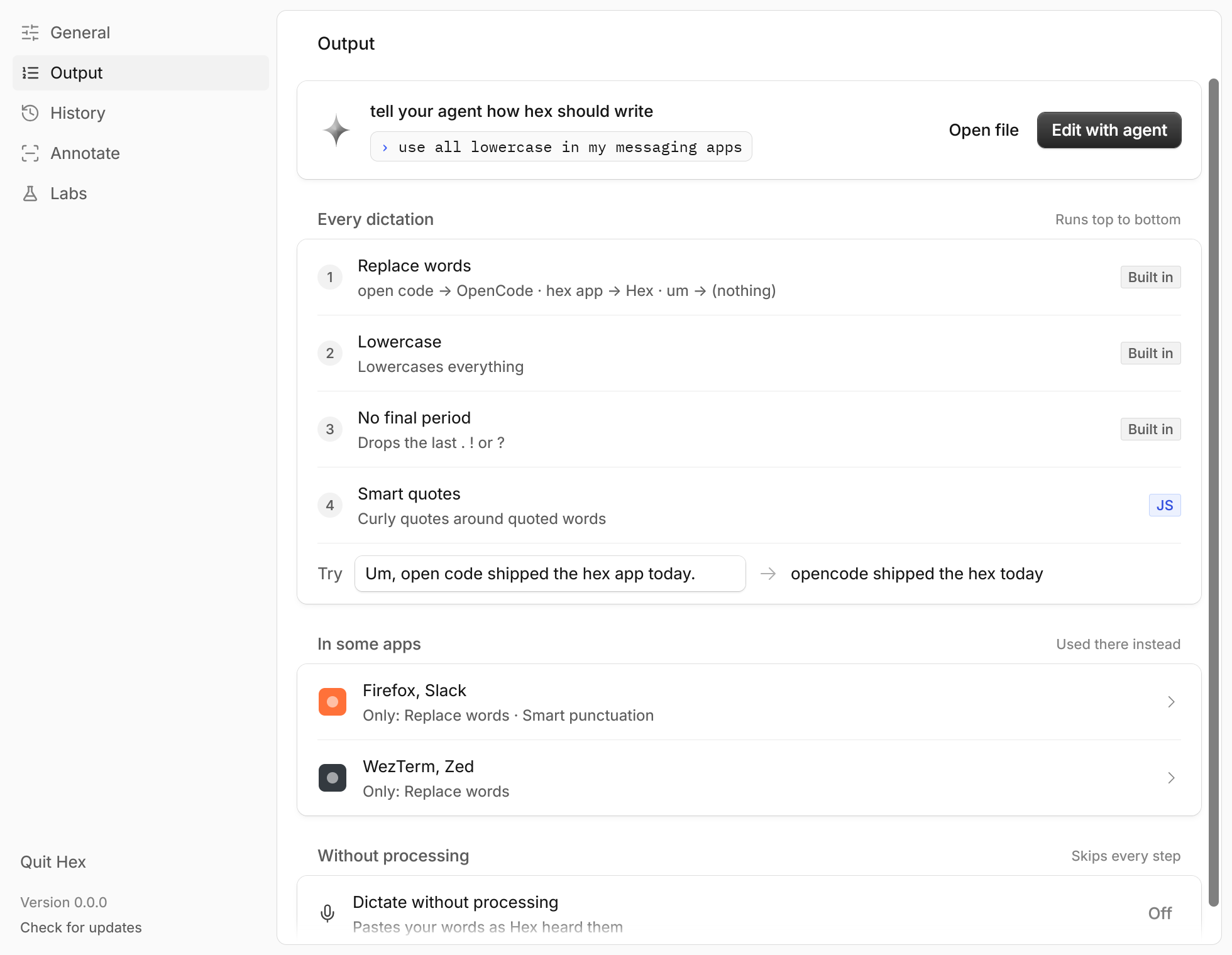
- Output runs every dictation through steps you choose (word replacements, built-in cleanups, your own scripts, an optional OpenCode rewrite), with different steps per app or website
- Vocabulary is one list of names Hex should know; Whisper and Qwen3-ASR read it while transcribing, Parakeet models read it with Labs › Vocabulary help on, and the OpenCode rewrite uses it
- Annotate records the screen while you draw and talk, on macOS, Linux and Windows (GNOME Wayland needs Labs › Annotate on GNOME)
- an authenticated local API and the TypeScript SDK transcribe with the same model, for your own tools
- Meetings is a macOS lab that records a call and writes the transcript
Output and History:

Speech models
Hex downloads one model the first time it runs and transcribes with it on your
machine from then on. On an English system that's Parakeet Unified English: it
writes while you talk, so the text is ready when you let go. Other languages
start with the model recommended for them. That model also serves meetings and
hex transcribe.
Settings' picker offers more, among others:
- Parakeet v3: 25 European languages, and it hears which one you speak
- Cohere Transcribe: the fewest wrong words, in 14 languages; a big download
- Whisper large-v3-turbo: almost any language, and it reads your vocabulary
- Qwen3-ASR 0.6B: Chinese and 29 more, and it reads your vocabulary
- SenseVoice Small: Chinese, Japanese, Korean and English; a small download
- Nemotron 3.5 ASR: writes while you talk, in 27 languages
- Granite Speech 5.0: IBM's model, seven languages, with punctuation
- one-language models: ivrit.ai Whisper for Hebrew, GigaAM v3 for Russian, NB-Whisper for Norwegian, KB-Whisper for Swedish, QwenCleo-ASR for Egyptian Arabic
- more English models: Parakeet v2 and Underdog Bark 3.0
Add a GGUF model of your own with "Add model file…" in the picker; see your own speech models.
Downloads
Stable is the current release. Dev is the newest build of dev and updates
itself from the dev channel.
| Platform | Stable | Dev |
|---|---|---|
| macOS (Apple silicon) | DMG | DMG |
| Windows x64 | Installer | Installer |
| Windows ARM64 | Installer | Installer |
| Linux x86_64 | Executable | Executable |
| Linux x86_64 (Debian, Ubuntu) | .deb | .deb |
| Linux x86_64 (Fedora, openSUSE) | .rpm | .rpm |
| Linux ARM64 | Executable | Executable |
| Linux ARM64 (Debian, Ubuntu) | .deb | .deb |
| Linux ARM64 (Fedora, openSUSE) | .rpm | .rpm |
Or install with:
- Homebrew:
brew install --cask anomalyco/tap/hex - AUR:
yay -S hex-bin - install script (Linux):
curl -fsSL https://anoma.ly/hex/install-linux.sh | sh - Nix (Linux):
nix profile add github:anomalyco/hex
Command line
hex transcribe meeting.m4a prints a recording's transcript, whether or not
the app is running. It reads WAV, AIFF, CAF, FLAC, MP3, Ogg, WebM, and
MP4/M4A/MOV, including a video's soundtrack. The same hex controls the
running app (hex status, hex dictation, hex settings); see
docs/cli.md.
On macOS the CLI is inside the app. Homebrew links it for you; otherwise link
it somewhere on your PATH that you own:
ln -s /Applications/Hex.app/Contents/MacOS/hex ~/.local/bin/hex
Linux and Windows installs put hex on your PATH.
More docs are in docs/.
Contributing
We don't take pull requests. Open an issue describing the bug or idea, and our agents usually turn it around fast.
MIT licensed.